
The short answer
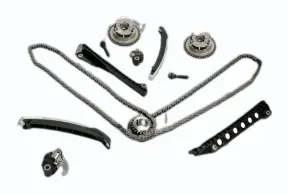
The timing chain keeps the camshafts turning in step with the crankshaft, so the valves open and close while the pistons are out of their way. It runs in oil and was fitted to last, but its pins and bushes wear, the chain grows longer, the tensioner runs out of travel and the plastic guide rails wear through. The first sign is a rattle from the front or the side of the engine at idle and at a cold start; on engines with variable valve timing, a fault code often comes first. A chain that has stretched past the manufacturer’s limit is replaced before it jumps a tooth, and it is replaced as a kit, because the chain, the sprockets, the rails and the tensioner wear together.
What the chain does
The RAC describes it in one sentence: a timing chain “synchronizes the crankshaft and camshaft, ensuring valves open and close at the right time during combustion when the engine is turned on.” The camshaft sprockets have twice the teeth of the crankshaft sprocket, so each camshaft turns once for every two turns of the crankshaft, and every valve opens and closes once per cycle at the angle the camshaft lobe dictates.
Chains replaced belts on many engines for a reason. Wikipedia notes that “metal timing chains have become more widespread in car engines produced since the 1990s in order to eliminate the regular maintenance interval replacement of a rubber timing belt.” A chain runs inside the engine, lubricated by engine oil, and does not perish with age the way rubber does. But “unlike rubber timing belts, chains last longer but still require proper lubrication in order to work correctly”, and in practice “they normally need to be replaced every 80,000 to 120,000 miles”, with the interval depending on the engine, the oil and how the car is driven.
Why a chain wears
The chain itself is the strongest part of the drive. Wikipedia puts it this way: “while the chains themselves are subject to minimal wear, lubrication of the chain or failure of the tensioner and chain guides can cause excessive wear or premature failure.” The pins and bushes of every link wear a little at every revolution; over a long life those small amounts add up and the chain is measurably longer. The hydraulic tensioner takes up the slack until it reaches the end of its travel, and the plastic faces of the guide rails, which the chain runs against, wear thin and break. Old, low or dirty oil speeds all of this up: the RAC lists “insufficient lubrication” among the things that damage a chain, and notes that “teeth (sprockets) on the camshaft can wear down over time, making it slip and cause misalignment in the engine.”
The signs of wear
| Sign | What is happening |
|---|---|
| A rattle from the front or the side of the engine at idle, loudest for a few seconds after a cold start | The chain is slack: the tensioner can no longer take up the stretch, and the chain slaps the guide rails and the cover |
| An engine warning light with a camshaft or crankshaft correlation fault code | The camshafts run behind the crankshaft by more than the control unit allows; on engines with variable valve timing this comes before the rattle |
| A rough idle, misfires, a loss of power | The valve timing has drifted with the stretch of the chain |
| Fine metal particles in the oil or in the filter, or pieces of plastic in the oil pan | The sprockets, the tensioner or the guide rails are wearing |
| The engine stalls or will not start after a bang | The chain has jumped a tooth or broken |
Wikipedia makes the point that a chain gives warning where a belt does not: “unlike typical metal-reinforced rubber timing belts, which give no indication of impending failure, worn timing chain system will produce a telltale rattling noise from the front of the engine”, and “later model VVT applications will generate engine codes and check engine lights prior to engine rattle.” The RAC sums the outcome up: “if worn or stretched, they can cause rattling noises, misfires, or severe engine damage.”
A workshop confirms the wear by measuring: with the camshaft locking tools fitted, the crankshaft position shows how far the timing has drifted, and the position of the tensioner piston shows how much travel is left. On many engines the control unit’s live data gives the same figure as a camshaft adaptation angle.
What happens if it fails
Most modern engines are what Wikipedia calls interference engines, “which can suffer catastrophic damage in the event of timing system failure, since the loss of synchronization between the crankshaft and the camshaft will cause the valves to collide with the pistons.” A chain that jumps one tooth throws the timing off and, as the RAC notes, “if the chain slips a tooth, the engine’s timing is thrown off, causing it to stall”; a chain that breaks bends valves, damages pistons and can crack the head. That is why a rattling chain is not driven on, and why, in the RAC’s words, “ignoring it could lead to a larger repair bill – and damage other crucial components in the engine.”
Why the whole kit is replaced
The chain, the sprockets, the guide rails and the tensioner have all worn together, and most of the cost of the job is the labour of reaching them. A new chain on worn sprockets wears quickly; worn rails let it whip; a tensioner at the end of its travel lets it slacken again. Renewing the drive as a kit, with new oil and a new filter, means the job is done once. Where the water pump or the oil pump is driven by the same chain and sits behind the same cover, it is inspected and often renewed at the same time.
MONTTRON supplies timing chain kits complete with the chain, the sprockets, the tensioner and the guide rails, together with VVT camshaft adjusters, camshafts and tensioner bearings for European and Japanese passenger cars, identified by OE reference.